

We're all in agreement that the color wheel is a bit of a myth.
Nature does neither use a color wheel nor color theory. Flowers don't worry about complementary colors before they bloom. The sky doesn't care if it clashes with the sea. But we build entire systems of design, art and "good taste" on a tidy circle of hues.
The wheel construction dates back to Newton. It had seen many iterations and variations. Newton was more interested to understand the nature of light, and not so much how we perceive combinations of colors.
The color wheel is only a tool for color schemes
The color wheel is one of the most widely taught tools in art and design. But what if it's just a convenient fiction? It's a visual framework we came up with to sort out perception, which can get a bit messy.
There's nothing "natural" about arranging red opposite green or organizing color into a wheel. It's not how light works, and it's not how pigments behave in the real world. We just made it up as we went along.
But here's the twist: it works.
It's not that it's true, but it is useful. The wheel shows how our brains simplify color relationships. We all love a bit of harmony, contrast and balance in our lives, so we built a tool that gives us exactly that.
It's not like it's a natural thing. It comes from us — our desire to make sense of what we see, to control it, to make it beautiful, predictable, manageable.
The color wheel isn't reality. It's a map of perception. A structure imposed on chaos. Maybe that's the real story, not about color, but about how far we'll go to turn the unknown into something we can name, teach and sell.
So use the color wheel as a tool that help us humans process colors. To come up with color schemes, talk in terms of color harmonies or craft color palettes. Label colors as primary color, secondary color, tertiary color or analogous color.
But don't be surprised, that nature has more color combinations to offer.
PS: BTW, use our wheel here is our version if an interactive wheel.
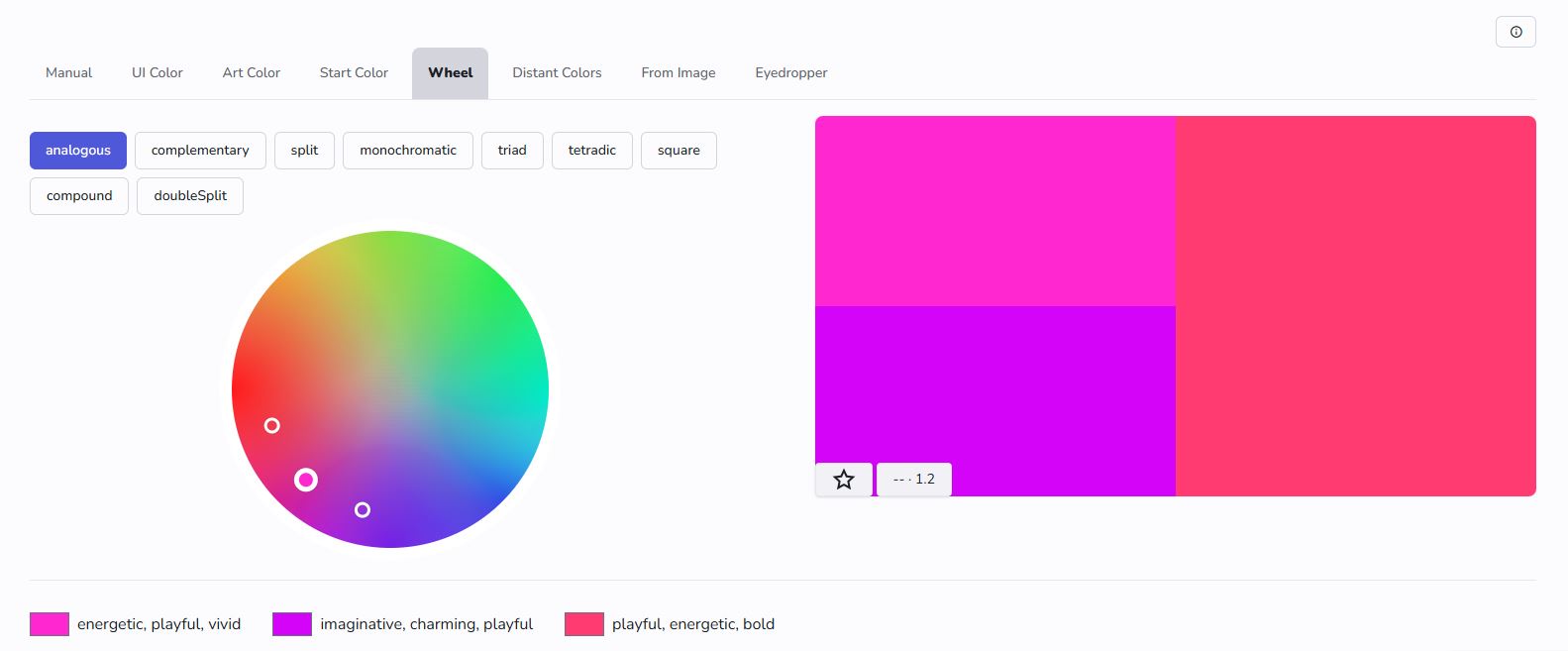
Play with
Complementary colors (opposites on the wheel) really do increase visual intensity when placed side-by-side.
Analogous colors feel calm because their wavelengths are close — they stimulate the eye similarly.
Triadic schemes offer visual balance because the colors are spaced evenly — like a stable triangle.